The Notes App Graveyard: Why Your Ideas Never Launch
By Team Build Theory · June 17, 2026 · 5 min read
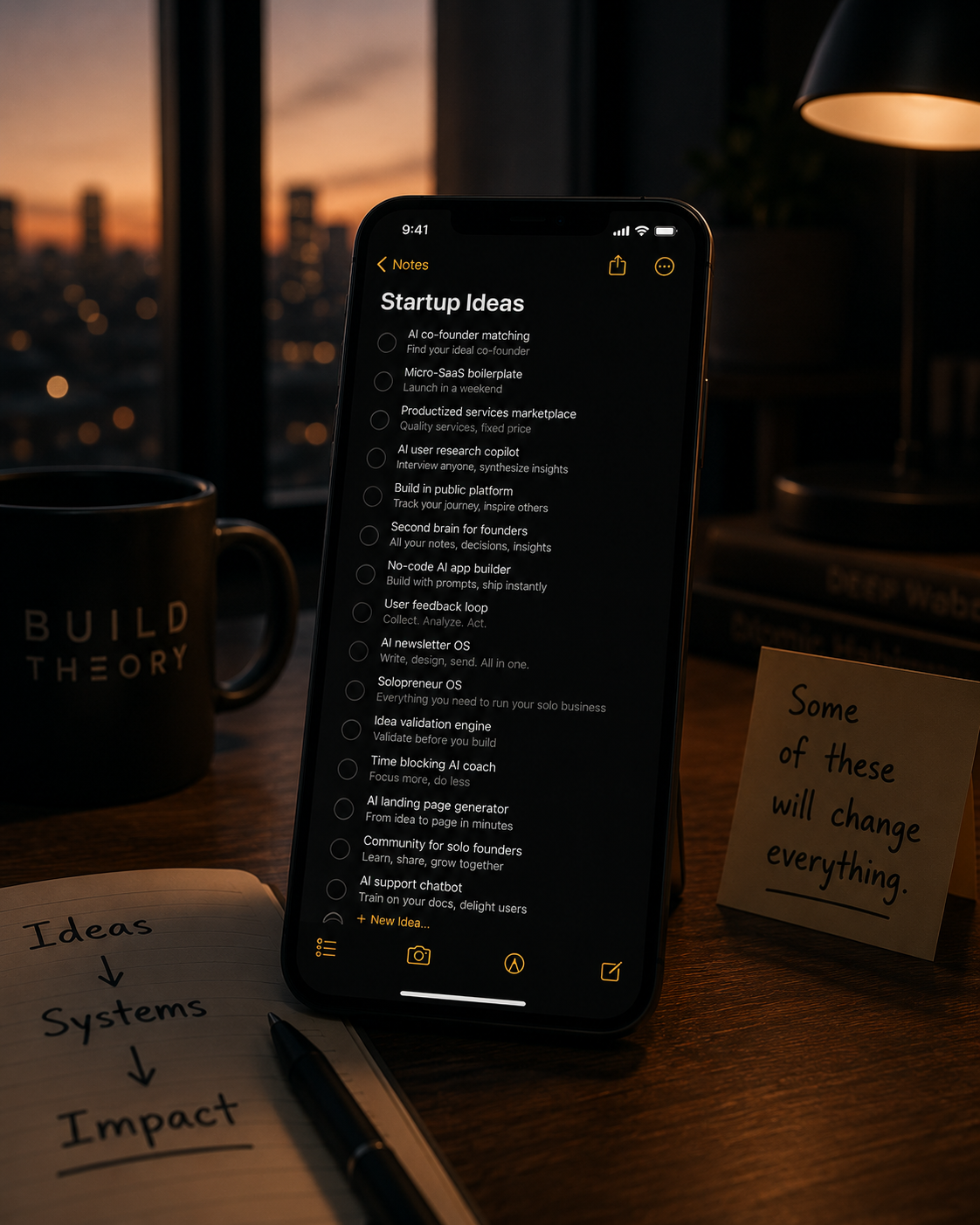
Most ideas never launch because the gap between intending to build and actually building is enormous — and a notes app makes it easy to keep collecting instead of shipping. Research on the intention-behavior gap shows people act on their good intentions only about half the time. The graveyard is normal. The escape is a system.
Welcome to the graveyard
Almost everyone has one: a notes app, a doc, or a folder full of ideas. 'An app for X.' 'A tool that does Y.' Some are genuinely good. Almost none get built. We collect ideas like souvenirs and mistake collecting for progress.
Why it happens (it is not laziness)
Psychologist Paschal Sheeran's well-known research on the intention-behavior gap found that intentions translate into action only around 53% of the time — roughly a coin flip — and that intentions explain only about a quarter of why people actually do things. In other words, wanting to build is a weak predictor of building. Knowing this is freeing: your unbuilt ideas are not a character flaw. They are the default human outcome without structure.
Three forces keep ideas buried:
• No deadline — 'someday' never arrives. Open loops stay open forever.
• No next physical step — 'build an app' is not an action; 'talk to five users tomorrow' is.
• The fantasy is safer than the attempt — an idea in your notes can never fail. The moment you build it, it can. So we protect the fantasy by never starting.
The Builder Gap
We call this distance the Builder Gap: the space between being able to build (tools are now cheap and easy) and actually building (you still don't). For the first time in history, ability is not the constraint. Execution is. That reframes everything — your problem is not a skills problem, it is a starting problem.
How to actually escape it
You do not escape the graveyard by having more discipline. You escape it by changing the conditions:
1. Pick one idea and kill the rest (for now). Collecting is the addiction. Commit to a single idea and close the notes app.
2. Set a hard, short deadline. Two to four weeks. Short enough to feel urgent, long enough to finish something real.
3. Define the smallest shippable version. What is the one thing the product must do for one person?
4. Make the next step physical and tiny. Not 'build the app' — 'message three potential users today.'
5. Add external accountability. A cohort, a mentor, a public commitment. The intention-behavior gap shrinks dramatically when someone is watching.
The cost of the graveyard
Every unbuilt idea is not just a missed product. It is a missed rep. Building is a skill that compounds — your tenth product is built far faster than your first. The graveyard does not just cost you ideas; it costs you the years of compounding you would have had if you had shipped the first one.
Frequently asked questions
What if my idea isn't good enough to build?
You cannot know that from your notes app. The only way to find out if an idea is good is to build a tiny version and put it in front of real people. A 'bad' idea you ship teaches you more than a 'great' idea you hoard.
How do I choose which idea to build first?
Pick the one where you personally have the problem or easy access to people who do. Proximity to the user beats cleverness of the idea, especially for your first build.
Turn one idea from your notes app into a real product in 30 days at edupodx.com/buildtheory
- #ideas never launch
- #notes app graveyard
- #execution gap
- #stop hoarding ideas
- #builder mindset
- #build theory